🌍 Engineered for West Africa — Côte d’Ivoire · Ghana · Burkina Faso · Senegal · MaliTalk to an engineer →
Fuel envelope

Biomass fuels: what the burner actually accepts

Cashew shell is the design fuel. It is not the only one.

The burner is multi-fuel: it runs on shells (cashew, palm kernel, coconut, groundnut), crop residues (corn cob, cotton stalk, rice husk), processing residues (palm fibre, coffee husk, cocoa pod husk) and wood fuels (sawdust, chip, pellet). Useful calorific value runs from roughly 3,200 to 5,100 kcal/kg depending on the fuel and its moisture.

The question we are almost always asked is "what is the calorific value?". It is the wrong question, or at least the fourth most important one. Two fuels both quoted at 4,000 kcal/kg can behave completely differently in the same chamber: one runs for a year without incident, the other welds the grate shut in three weeks.

The design fuel, and the rest

The burner was sized around cashew shell, and for good reasons: it is dense, low in ash, dry as it leaves the sheller, and it is produced in exactly the places where the mango, the cashew and the drying crops are. In Côte d’Ivoire, the world’s largest raw cashew producer, it is the most available residue in the country.

But designing around a fuel is not being locked into it. A dryer in Senegal will source groundnut shell more easily; in Mali, cotton stalk; in forest Guinea, palm kernel shell. The table below covers the real envelope, with what each fuel costs you in handling — because that is where the decisions are actually made, not in the kcal column.

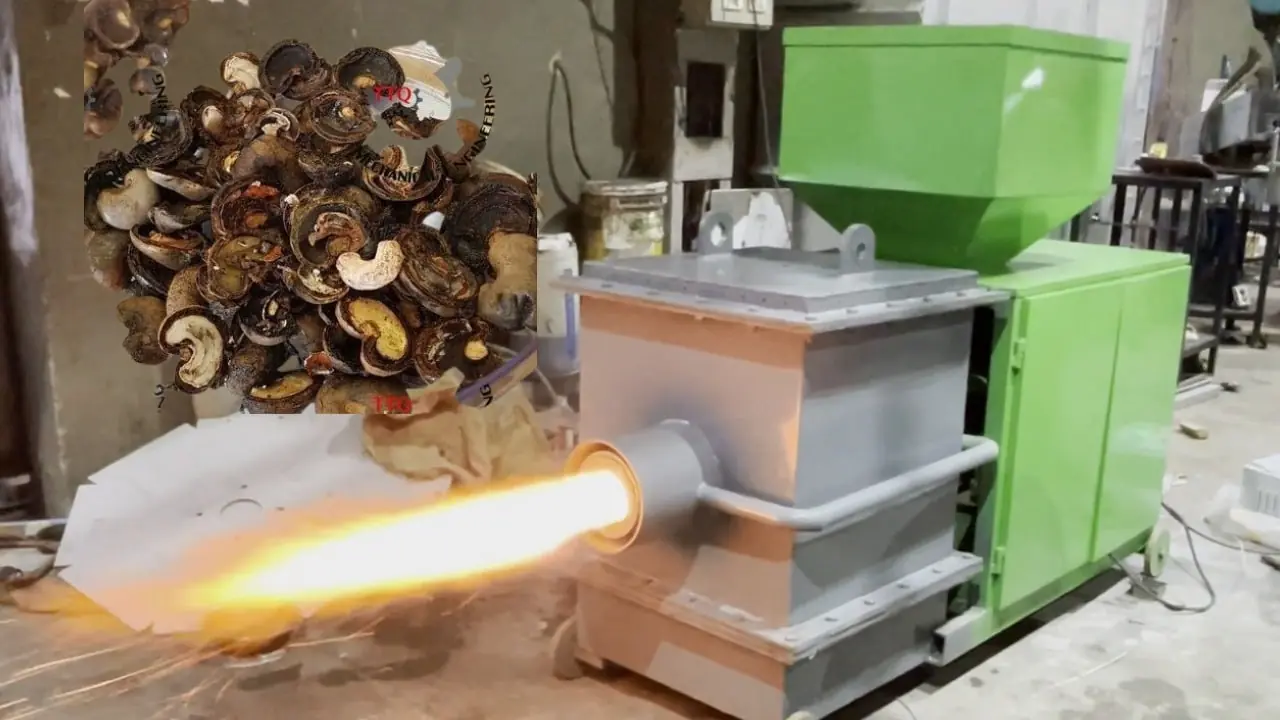
The burner on test, firing on cashew shell. — illustrative image, not a photograph of a completed installation
The burner on test, firing on cashew shell.

What actually decides whether a fuel works

Moisture, above all

Every kilogram of water in the fuel consumes about 540 kcal simply to evaporate, taken from the energy you meant to send to the dryer. It is the most underestimated factor by a wide margin.

Ash content

It sets the de-ashing interval and the volume you have to remove. At 2 % ash you de-ash at the end of a shift. At 20 % it becomes a production operation in its own right.

Ash chemistry

This is the real trap. Fuels rich in potassium and chlorine — straws, palm empty fruit bunch, cocoa pod husk — have a low ash melting point and form clinker on the grate. A fuel can be excellent in a calorimeter and unworkable in service.

Bulk density

It fixes hopper volume, screw sizing and storage area. Groundnut shell at 150 kg/m³ takes four times the volume of palm kernel shell at 600 kg/m³ for the same energy.

Form

Loose, briquette or pellet: the form has to match the feed system. A light, bulky fuel gets briquetted, or the hopper will not hold an eight-hour shift.

What moisture really costs

The arithmetic is worth doing once, because it changes purchasing decisions. Take a dry matter of 4,400 kcal/kg, delivered at two different moisture contents.

Fuel at 10 % moistureFuel at 50 % moisture
Dry matter in 1 kg as delivered0.90 kg0.50 kg
Gross energy available3,960 kcal2,200 kcal
Water to evaporate0.10 kg0.50 kg
Energy consumed by that water (≈ 540 kcal/kg)−54 kcal−270 kcal
Net energy to the dryer≈ 3,900 kcal/kg≈ 1,930 kcal/kg

The wet fuel delivers less than half the useful energy of the dry one, from identical dry matter. You also pay to transport that water, and you handle twice the tonnage for the same heat. This is why bagasse at 50 % and palm empty fruit bunch at 60 % appear in the table with a warning rather than a recommendation.

The fuel envelope

Twenty-seven fuels, grouped by family. Values are ranges because biomass is an agricultural product: two lots of rice husk from the same mill differ by more than a single value would suggest.

FuelNCV (kcal/kg)Moisture (%)Ash (%)Density (kg/m³)FormAsh behaviour
Shells and kernels
Cashew shellThe design fuel. A shelling residue: dense, low in ash, and available where the mango grows.GREENMACH specification4,8008–121–3300–400LooseLow
Cashew cake (de-oiled)Shell after CNSL extraction. Lower in energy than raw shell, still excellent.Published range4,000–4,6008–123–6400–500CakeLow
Palm kernel shellThe densest fuel here. Stores and transports well; abundant anywhere there is a palm oil mill.Published range4,200–4,80010–182–5550–650LooseLow
Coconut shellHigh energy, very low ash. Often diverted to activated carbon, which bids up the price.Published range4,300–4,9008–121–3500–600LooseLow
Groundnut shellVery light loose — briquette it, or the hopper will not hold a shift. The fallback fuel of the groundnut belt.GREENMACH specification4,5008–103–6150–200BriquetteMedium
Shea cake and shellResidue from shea butter units. Ash varies with how well the nuts were cleaned.Published range4,000–4,80010–154–8350–450CakeMedium
Sunflower huskA good fuel, but residual oil means watching for deposits in the flue.Published range4,200–4,7008–122–4200–300LooseMedium
Wood fuels
Wood pelletThe reference fuel: dry, graded, low ash, feeds automatically without fuss. It is also the most expensive.Published range4,000–4,5006–100.5–1.5600–700PelletLow
SawdustVery low ash. Sawmill moisture decides everything: at 35 %, a third of the energy goes into drying the fuel.Published range3,800–4,40010–350.5–2150–250LooseLow
Wood chipOnly worth considering with a drying yard. Green chip will not hold a stable setpoint.Published range3,600–4,30020–450.5–2200–300LooseLow
BambooFast growing with good energy yield; higher silica than wood.Published range3,900–4,40010–201–3250–350ChipMedium
Crop residues
Corn cobThe best of the crop residues: low ash, dries quickly, briquettes well.GREENMACH specification4,10010–151–3200–300BriquetteLow
Corn stalkBulky and alkali-rich. Briquette it, and blend rather than firing it alone.Published range3,600–4,10010–205–1050–120BriquetteHigh
Cotton stalkAbundant across the West African cotton belt, and burned in the field for want of an outlet.GREENMACH specification3,90010–153–6150–200BriquetteMedium
Cottonseed hullAn oil-mill residue, more consistent than the stalk and easier to feed.Published range4,000–4,4008–123–5180–250LooseMedium
Rice huskAlways available, usually free, and 15–22 % abrasive siliceous ash. Plan the de-ashing and the wear.Published range3,200–3,8008–1215–22100–150LooseHigh
Rice strawThe worst ash behaviour here: high potassium and chlorine, low melting point, guaranteed clinker without the right grate.GREENMACH specification3,80010–1512–2050–100BriquetteHigh
Sugarcane bagasseAsh is manageable, but it leaves the mill at close to 50 % moisture. Dry it or blend it.Published range3,600–4,20045–522–5100–160LooseMedium
Sesame stalkAvailable at the end of the sesame campaign; alkali-rich, best blended.Published range3,700–4,20010–155–9100–180BriquetteHigh
Soybean huskConsistent and easy to feed wherever there is soy crushing.Published range3,700–4,2009–134–6200–300LooseMedium
Processing residues
Palm fibre (mesocarp)Usually burned on site at the mill. Wet, but free and to hand.Published range3,500–4,20030–405–8200–300LooseMedium
Palm empty fruit bunchVery wet and chlorine-rich. The hardest fuel here; avoid unless it is pre-dried.Published range3,300–4,00055–654–8150–250ShreddedHigh
Coffee husk and parchmentConcentrated at washing stations. Dries well, feeds well.Published range3,800–4,30010–153–8250–350LooseMedium
Cocoa pod huskA huge unused resource in cocoa country, but very high in potassium — blend, do not fire it alone.Published range3,300–3,90010–208–12200–300BriquetteHigh
Dried mango peelYour own line’s waste, returned to the burner. Must be dried before briquetting.GREENMACH specification4,2008–124–8450–550BriquetteMedium
Cassava peelOften carries soil, which drives the ash up. Wash before drying.Published range3,400–4,00012–205–12150–250BriquetteHigh
Rice branGood calorific value, but it competes with animal feed and runs high in ash.Published range4,000–4,5009–138–14300–400LooseHigh

Values marked "GREENMACH specification" are from our own technical documentation and are quoted unchanged in our proposals. The rest are typical ranges from the biomass characterisation literature: they describe the material as a class, not a test run on our burner. Have your actual fuel analysed before sizing a supply contract on it.

Slagging: the failure mode that matters

Biomass ash melts well below flame temperature when it is rich in potassium and chlorine. The molten mixture freezes as it cools into a hard glassy mass that blocks the grate and starves the primary air. The symptom is a gradual loss of output over two to three weeks, followed by a shutdown to chisel it off.

This is not a fault in the burner, it is a property of the fuel, and it is manageable: blend a risky fuel with a low-ash shell, hold a lower bed temperature, or specify the right grate at the point of order. What is not manageable is discovering it after commissioning.

  • Low — ash stays powdery. De-ash on a normal cycle.
  • Medium — will sinter if the bed is run hot or starved of air.
  • High — clinker is predictable, not occasional. Blending, the right grate or a reduced bed temperature, decided before the order.

What is available, country by country

A fuel that does not exist within a hundred kilometres of your unit is not a fuel. Here is what genuinely arises in volume across the ten countries we work in most, separating what can carry the base load from what only serves as a supplement.

Burkina Faso

Burkina combines cashew shell (Cascades, Hauts-Bassins), abundant cotton stalk after the cotton campaign, and shea cake. Mango peel supplements during the mango campaign itself.

Base load: Cashew shell · Cotton stalk · Shea cake and shell

Supplement: Corn cob · Groundnut shell · Sesame stalk · Dried mango peel

Côte d'Ivoire

The world’s largest raw cashew producer: shell is the most available fuel in the country. Palm kernel shell and fibre in the south, cocoa pod husk throughout the forest zone.

Base load: Cashew shell · Palm kernel shell · Cocoa pod husk

Supplement: Palm fibre (mesocarp) · Coffee husk and parchment · Rice husk · Coconut shell

Where this equipment is used

The same equipment is specified across several product classes. These are the ones it is configured for most often:

industrial mango drying system, fish and seafood drying, fruit and vegetable drying and livestock feed drying.

Each of those pages carries the drying parameters, cycle times and quality targets for that product class.

One system has been commissioned so far: a 900,000 kcal/h cashew shell burner firing a steam boiler at Premium Cashew Commodities Limited in The Gambia, on the factory’s own empty shell. It is a boiler application — no drying line has been built anywhere yet, so every drying figure on this site remains an engineered design target. The configuration is published in full, and the measured performance deliberately is not, on the page for the PCCL installation in The Gambia.

Frequently asked questions

Can I switch fuels without modifying the burner?

Between fuels of similar form and density, yes — moving from cashew shell to palm kernel shell, both above 300 kg/m³, needs only an adjustment. Moving from a dense loose fuel to a briquette at 150 kg/m³ changes the screw’s volumetric throughput and needs recalibration. A change of family is planned, not improvised mid-campaign.

What is the best biomass fuel for a dryer?

The one available year-round within a hundred kilometres, below 15 % moisture and 5 % ash. On that test cashew shell, palm kernel shell and coconut shell lead, between 4,200 and 4,900 kcal/kg with ash under 3 %. Calorific value rarely decides it; availability does.

Why avoid rice husk when it is free?

It is not really free. At 15 to 22 % abrasive siliceous ash it forces daily de-ashing, wears the parts it touches, and returns only 3,200 to 3,800 kcal/kg. It remains usable, but as part of a blend and with a maintenance budget you have accepted.

Do I need to briquette the fuel?

It depends on bulk density. Above roughly 300 kg/m³ — cashew, palm kernel, coconut shell — loose is fine. Below it, such as groundnut shell at 150 kg/m³ or corn stalk at 50 kg/m³, the hopper will not hold an eight-hour shift and briquetting becomes necessary.

Can fuels be blended?

Yes, and it is often the right answer. Blending a difficult-ash residue — straw, cocoa pod husk — with a low-ash shell lowers the overall alkali content and pushes the ash melting point back up. Aim for a blend whose overall ash stays under 6 %.
Have your fuel checked

Tell us what is available around your site and we will tell you what it means for the grate, the hopper and the way it is run.

Ask for an assessment