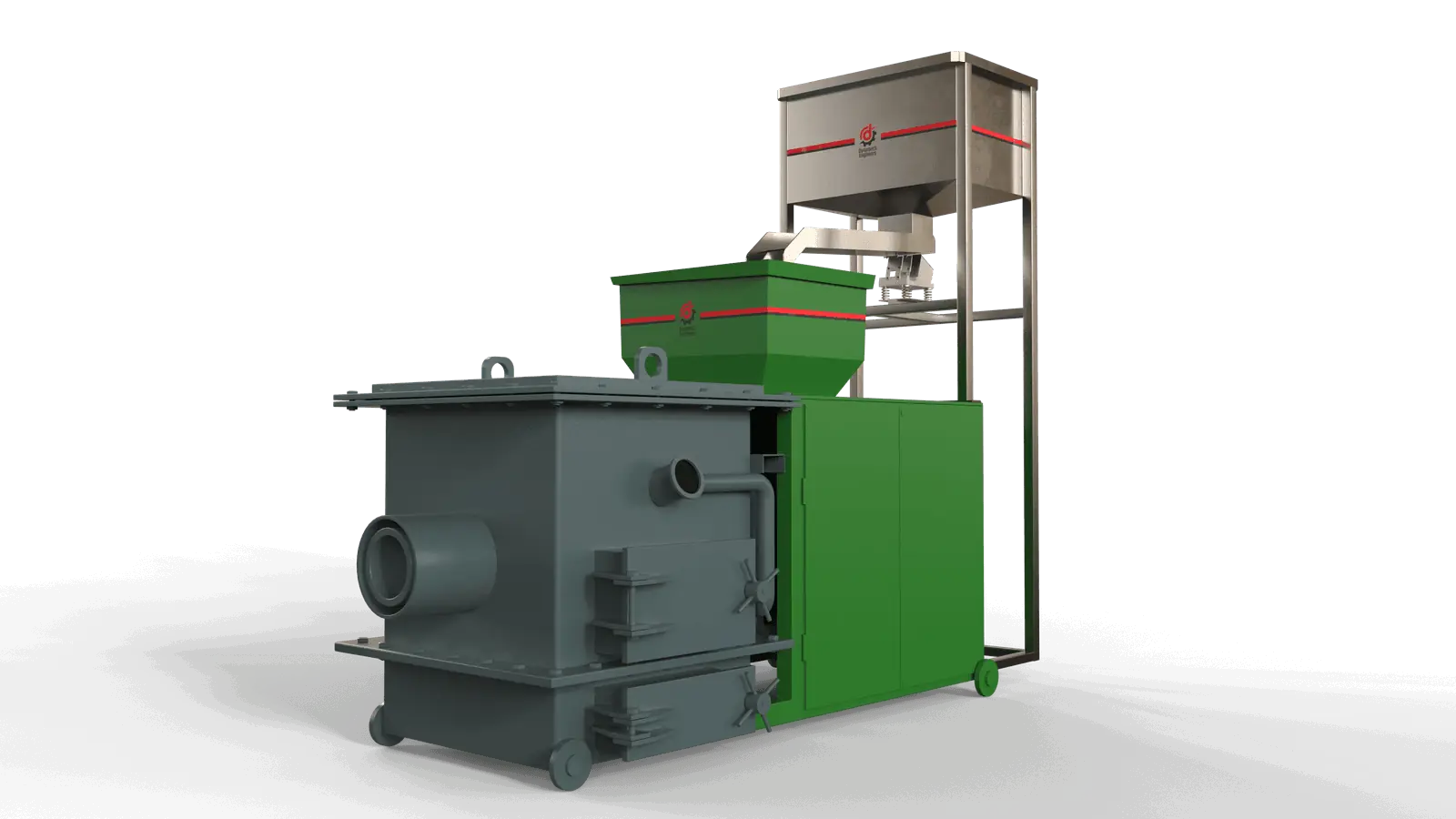
 Illustrative
Combustion
Commercial Biomass Burners
Sustainable heat from 200,000 to 900,000 kcal/h, running on cashew shells and validated agricultural residues. PLC-automated pyrolysis combustion.
One heat platform, configured to your line.
Three families of equipment share one combustion core: biomass burners rated 200,000 to 900,000 kcal/h, hot air generators delivering 2,500 to 3,000 m³/h at a controlled 50 to 150 °C, and drying chambers from a 100 kg cabinet to a six-chamber line. They are specified together or bought separately.
Every system is built around the same reliable cashew-shell combustion core — from a single batch chamber to an integrated multi-tunnel plant. Three families, one point of responsibility.
IllustrativeSustainable heat from 200,000 to 900,000 kcal/h, running on cashew shells and validated agricultural residues. PLC-automated pyrolysis combustion.
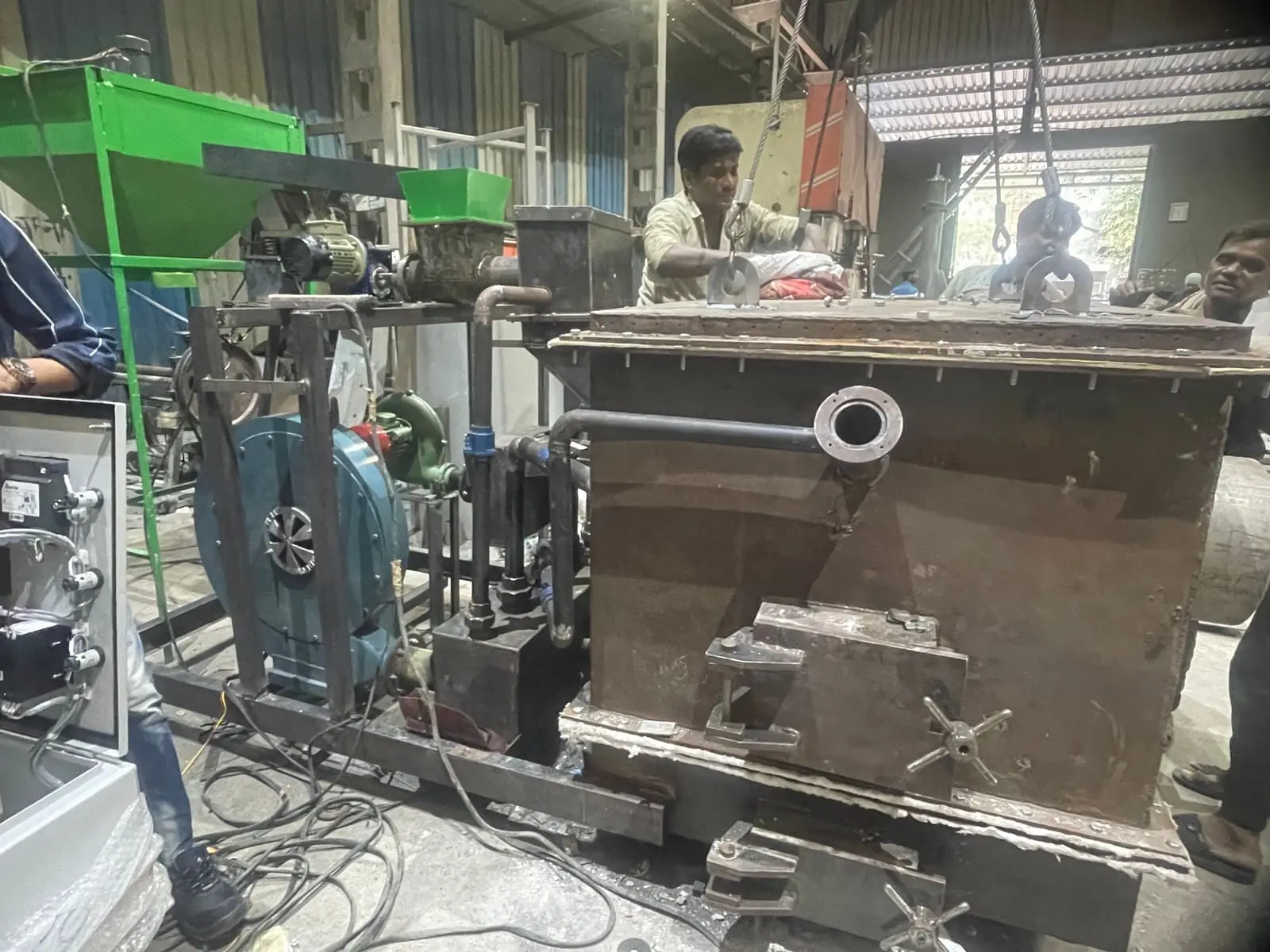 Illustrative
Double-chamber, three-pass heat exchange delivering 2,500–3,000 m³/h of clean, indirect-heated air at a controlled 50–150 °C — no combustion products in contact with product.
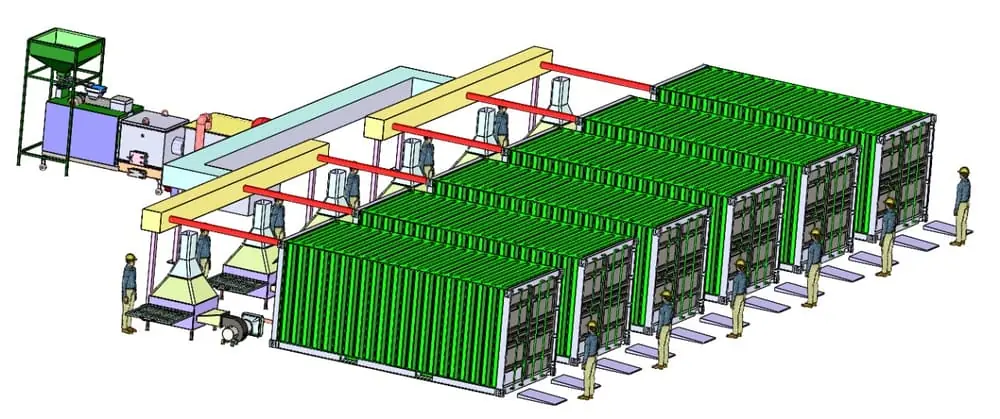 Illustrative
Complete systems — burner, generator, ducting and chambers — engineered as one unit and delivered under a single scope. 1,500 kg per batch, single tunnel to multi-tunnel plant.
Fourteen equipment pages, one row each. Ranges are the working envelopes rather than a single model, because every line is sized against its own duty.
| Equipment | Range | Family |
|---|---|---|
| commercial biomass burner | 200,000–900,000 kcal/h | Combustion |
| cashew shell burner | 200,000–900,000 kcal/h | Combustion |
| biomass pellet burner | 200,000–900,000 kcal/h | Combustion |
| agricultural waste burner | 200,000–900,000 kcal/h | Combustion |
| custom burner solutions | Outside the standard range | Combustion |
| biomass steam boiler firing | 1,000 kg/h at 10 bar on ≈150 kg/h shell | Combustion |
| steam for cashew processing | 550–650 kg of shell per tonne of raw nut | Combustion |
| biomass hot air generator | 2,500–3,000 m³/h at 50–150 °C | Process air |
| industrial tunnel dryers | 1,500 kg per standard chamber | Drying |
| cocoa and coffee drying equipment | Cocoa 50–60 °C · coffee 45–55 °C | Drying |
| panel-room drying | 828 kg per chamber, six-room line | Drying |
| batch processing units | 100–500 kg per unit | Drying |
| complete integrated systems | Burner to chamber, one scope | Complete line |
| custom drying solutions | Where nothing standard fits | Complete line |
Three questions settle it, and only the second is about size. Most buyers arrive having answered the first two and not the third, which is the one that decides whether they are buying heat or a line.
| If you… | Then start at |
|---|---|
| already own dryers, ovens or a boiler and want to stop buying diesel or LPG | a burner — the heat stage only, ducted to what you have |
| need clean, filtered air at a held setpoint for a food process | a hot air generator, because the exchange has to be indirect |
| run one crop at volume through a compressed season | tunnel chambers at 1,500 kg, sized on the peak day |
| run several products across the year and need to zone them | panel rooms, which clean and change over room by room |
| are starting small, or change product weekly | batch units at 100–500 kg, where changeover is the point |
| want one contract from fuel to finished product | a complete integrated system |
The question people skip is the last one: heat, or a line. Buying a burner when you needed a line means integrating two suppliers yourself; buying a line when you already own serviceable chambers means paying twice for the same steel.
Design and sizing, manufacture and quality control, sea packing and export documentation, installation supervision, commissioning and performance testing, operator and maintenance training, and the full documentation set. Lead time is 10–18 weeks from confirmed order and receipt of advance payment, with a 12-month warranty from date of shipment.
Civil works, the building, electrical supply to the panel terminals, water to one connection point, customs clearance and erection labour are the buyer’s. The scope is written out in full, exclusions included, on the industrial tunnel dryers page, and on the biomass dryer manufacturer page.
One system has been commissioned so far: a 900,000 kcal/h cashew shell burner firing a steam boiler at Premium Cashew Commodities Limited in The Gambia, on the factory’s own empty shell. It is a boiler application — no drying line has been built anywhere yet, so every drying figure on this site remains an engineered design target. The configuration is published in full, and the measured performance deliberately is not, on the page for the PCCL installation in The Gambia.
Yes, and a good share of enquiries are exactly that: an existing oven, dryer or boiler that costs too much to run on diesel or LPG. The burner is supplied with its controls and the ducted interface to your equipment, anywhere in the 200,000 to 900,000 kcal/h range.
The burner makes heat, the hot air generator moves it into a clean air stream through an indirect exchanger, and the chambers hold the product in that air at a setpoint between 40 and 100 °C. Any two can be bought without the third, but the exchanger is not optional for food.
A batch unit at 100 to 500 kg per load, on a burner at the 200,000 kcal/h end. Below that the economics stop working: the controls, the exchanger and the fuel handling cost much the same whatever the chamber holds, so a very small chamber pays for capability it cannot use.
Share your product, volume and available fuel — we’ll recommend the right family and size against your calculated heat demand.
Get a quote