Industrial tunnel dryers — 1,500 kg per batch
Where the specification holds or fails.
An industrial tunnel dryer is an insulated chamber through which heated air is circulated at a controlled velocity to reduce a product to a target moisture content. SahelDry chambers hold 1,500 kg per batch, operate between 40 and 100 °C at 2.0–3.0 m/s, and are built from 100 mm rockwool-core sandwich panel with a 120-minute fire rating.
Every upstream component exists to deliver clean air at a controlled temperature into this chamber. Everything that determines final quality — uniformity, colour, moisture consistency, microbial safety — is decided by what happens inside it.
Indicative price, Ex-Works (EXW): USD 6,280–41,885
Shipping, customs clearance and local duties are extra. The final price depends on the configuration and is fixed in the written quotation.
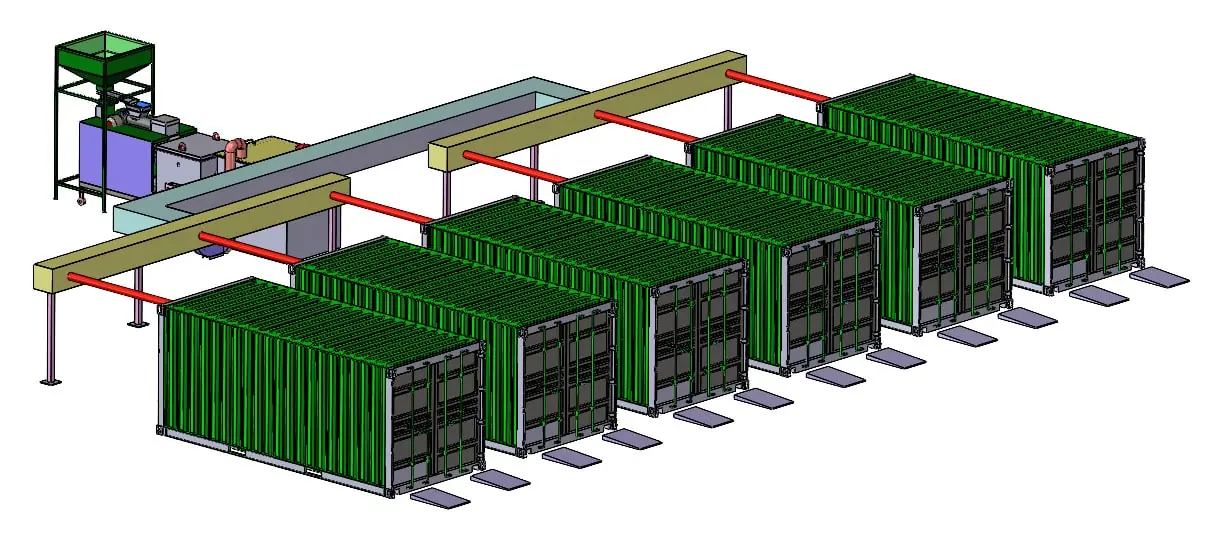
Chamber construction
| Parameter | Value |
|---|---|
| Panel system | 100 mm prefabricated sandwich panels, continuous-process manufactured |
| Core | High-density lamellar rockwool, min. 100 kg/m³ |
| Facing sheets | 0.5 mm TCT min., 240 MPa, galvalume with 150 gsm alu-zinc coating |
| Thermal conductivity | 0.04 W/m·K maximum |
| Fire rating | 120 minutes; non-combustible to BS 476 Part 4; Euro Class A1 to EN 13501-1 |
| Water absorption | under 1% to BS 2972:75 |
| Moisture resistance | under 0.02 vol% to ASTM C 1104 |
| Sound reduction | 25–30 dB transmission loss |
Doors: 40 mm double-leaf fire-rated, 2440 × 2590 mm with frame; stainless hinges, 200 × 300 mm view glass, door and drop seals.
Air distribution
- Dedicated chamber blower — 3 HP, belt driven, 600 mm impeller, drawing hot air into the chamber.
- Twin axial circulation fans per tunnel — establishing an even flow pattern throughout the load.
- Volume-control dampers — precise supply regulation, allowing chambers to run different products simultaneously.
- MERV 8 filtration — clean supply air, protecting both product quality and equipment.
- Exhaust system — continuous removal of moisture-laden air, without which drying rate collapses as humidity rises.
Performance specifications
| Parameter | Value |
|---|---|
| Batch capacity | 1,500 kg per chamber (standard) |
| Hot-air temperature | up to 100 °C at generator, controlled at chamber |
| Working range | 40–100 °C |
| Air velocity | 2.0–3.0 m/s, product dependent |
| Automation | Full PLC control with recipe management |
| Configuration | Single chamber to multi-chamber plant (Banfora = six container chambers) |
Product parameters
Mango dries at 65–70 °C over 16 to 20 hour cycles to a final moisture of 12–14%; fish dries more gently, at 45–50 °C over 24 to 30 hours, to 15–20%.
| Product | Temperature | Air velocity | RH | Cycle | Final moisture | Loading |
|---|---|---|---|---|---|---|
| Mango | 65–70 °C | 2.5–3.0 m/s | 30–40% | 16–20 h | 12–14% | 35–40 kg/m² |
| Fish | 45–50 °C | 2.0–2.5 m/s | 35–45% | 24–30 h | 15–20% | 25–30 kg/m² |
How many chambers you need
The chamber count follows from three numbers and nothing else: how much fresh product arrives on your busiest day, how much one chamber holds, and how many batches a chamber turns in twenty-four hours. Guessing any of the three is what produces a line that idles in one season and cannot cope in the next.
Batches per day come from the cycle plus turnaround — unloading, cleaning and reloading. A mango cycle of 16 to 20 hours gives one batch per chamber per day and no more; there is no arrangement of shifts that gets two out of it. Fish at 24 to 30 hours gives one batch every day and a half, so the same tonnage needs roughly half as many chambers again.
Worked from a standard tunnel chamber
| Parameter | Value |
|---|---|
| Daily fresh intake | 9,000 kg on the peak day |
| Chamber capacity | 1,500 kg per batch — standard tunnel chamber |
| Cycle | 16–20 h for mango, so one batch per chamber per day |
| Chambers required | 9,000 ÷ 1,500 ÷ 1 = 6 |
| Line batch | 6 × 1,500 kg = 9,000 kg fresh |
| Dried output | ≈ 900 kg per day at a 10:1 whole-fruit yield |
The same six-chamber line built as 20 ft container conversions holds 828 kg per chamber rather than 1,500 kg, because the container fixes the footprint at 8 wagons — 4,968 kg fresh per line batch on a 14-hour cycle. That is a different product, not a different way of counting the same one: quote the format alongside the tonnage or the two figures will be read as a discrepancy.
What is included, and what is not
Published in full, because a quotation that leaves these boundaries implicit ends in variation orders. The final scope is confirmed in writing with the proposal.
In our supply
- Design and sizing from your product, tonnage and target moisture
- The chambers: panels, doors, trays, wagons, blowers, dampers and filtration
- The heat stage — burner and hot air generator — where taken as one line
- PLC, HMI, instrumentation and the control panel
- Manufacture and quality control
- Sea packing and export documentation
- Installation supervision on site
- Commissioning, temperature mapping and performance testing
- Operator and maintenance training
- Manuals, maintenance schedules and spare-parts lists
The buyer’s responsibility
- Civil works, foundations and the floor slab
- The building or shed the chambers stand in
- Electrical supply to the panel terminals
- Water supply to one connection point
- Customs clearance and inland transport
- Erection labour and lifting on site, under our supervision
- Outside West Africa: the team’s travel, accommodation and entry formalities
Commercial terms
The same terms apply wherever the equipment goes. Nothing here changes with destination except who pays for the installation team to get there.
| Item | Value |
|---|---|
| Manufacturing lead time | 10–18 weeks from confirmed order and receipt of advance payment |
| Warranty | 12 months from date of shipment |
| Spare parts | Dispatched alongside the machines |
| Design life | 15–20 years, main structure; grills are consumable |
| Training | Operators and maintenance, included at commissioning |
| Electrical supply | 400 V / 230 V, 3-phase, 50 Hz, TN-S; supply subject to interruption |
Tunnel dryer or batch unit?
Three configurations share the same burner and hot air generator and differ in how the product moves through the heat. Most buyers have already decided on throughput grounds without realising that hygiene and product mix decide it more often.
| Tunnel dryer | Panel room | Batch unit | |
|---|---|---|---|
| Capacity | 1,500 kg per chamber | 828 kg per container conversion | 100–500 kg per unit |
| Product movement | Wagons along a line | Wagons into a room | Static trays in a cabinet |
| Best at | One product at volume | Several products, zoned | Small volumes, frequent changeover |
| Changeover | Full wet clean between products | Room by room, others keep running | Fast — the point of the format |
| Typical buyer | Exporter with a single crop peak | Processor with a mixed calendar | Cooperative or growing SME |
The question that settles it is not tonnage but how many different products cross the floor in a year. A single-crop exporter is better served by tunnels; anyone running mango, then fish, then chilli through the same season should look hard at zoning before buying throughput.
See panel-room drying and batch processing units for the two alternatives in full, or complete integrated systems for how the heat stage is shared between them.
Going deeper
- Tunnel dryers for food processing — hygienic design, SS 304 throughout, filtration and cleaning between products.
- Sizing a tunnel dryer — from fresh tonnage to chamber count, and the efficiency chain behind the fuel figure.
What this is — and what it is not
A food tunnel dryer dries a product to a target moisture content. Other equipment carries the same name: ink-curing tunnel dryers in printing, finishing tunnels in industrial laundry, and freezing tunnels in cold chain. These are different machines.
| Food tunnel dryer (this page) | Printing, laundry and freezing tunnels | |
|---|---|---|
| What is processed | Food: mango, fish, fruit, vegetables, spices | Ink on a printed substrate, washed textiles, product being frozen |
| Objective | Bring the product to a shelf-stable moisture content | Cure an ink, finish a textile, lower temperature |
| Temperature range | 40 to 100 °C, held to a process setpoint | UV or infrared, or sub-zero in freezing tunnels |
| Hygiene requirement | Food contact, SS304, one-directional product flow | Not applicable, or a different hygiene regime |
| Heat source | Indirect hot air from a biomass burner | UV lamps, electric elements, steam, or refrigeration |
| Typical buyer | Food or agro-processor, exporter | Printer, industrial laundry, frozen-food processor |
If you are curing ink, finishing laundry or freezing product, this is not the equipment described here.
Where this equipment is used
The same equipment is specified across several product classes. These are the ones it is configured for most often:
industrial mango drying system, fish and seafood drying and fruit and vegetable drying.
Each of those pages carries the drying parameters, cycle times and quality targets for that product class.
One system has been commissioned so far: a 900,000 kcal/h cashew shell burner firing a steam boiler at Premium Cashew Commodities Limited in The Gambia, on the factory’s own empty shell. It is a boiler application — no drying line has been built anywhere yet, so every drying figure on this site remains an engineered design target. The configuration is published in full, and the measured performance deliberately is not, on the page for the PCCL installation in The Gambia.
Frequently asked questions
How many chambers do I need?
It follows from your daily fresh intake and the product cycle time. One 1,500 kg chamber on a 16–20 hour mango cycle handles one batch a day. Six chambers is a common line and matches a burner of roughly 600,000 kcal/h — indicative orientation only, not a sizing rule.
Can one tunnel dry different products?
Yes, anywhere in the 40–100 °C range, provided PLC recipes are set per product. The limits are hygienic rather than thermal: strongly aromatic products, allergens and switching between fish at 45–50 °C and fruit at 65–70 °C call for cleaning protocols or dedicated chambers. SS304 trays and wagons take a full wet clean between products.
What is the difference between a tunnel dryer and a panel room?
A tunnel moves air along a line of wagons at 1,500 kg per chamber; a panel room is an insulated room with its own recirculation, six rooms making a 4,968 kg fresh mango line batch. Tunnels favour throughput, panel rooms favour product flexibility and hygienic zoning.
Request a tunnel-dryer proposal
From a single chamber to a multi-tunnel line, sized to your daily volume.
Request a proposal