Industrial fish and seafood drying systems
A narrower margin than fruit — and we engineer for it.
Industrial fish drying removes moisture at a low enough temperature to avoid cooking the protein while staying above the range where spoilage organisms multiply. SahelDry lines run at 45–50 °C over 24–30 hour cycles to a final moisture of 15–20 %, with humidity control and hygienic zone separation designed in from the outset.
Fish drying is less forgiving than fruit drying. The raw material deteriorates rapidly from the moment of landing, and the consequences of getting it wrong are a food-safety incident, not a quality complaint. Controlled drying replaces guesswork with a validated, documented process.
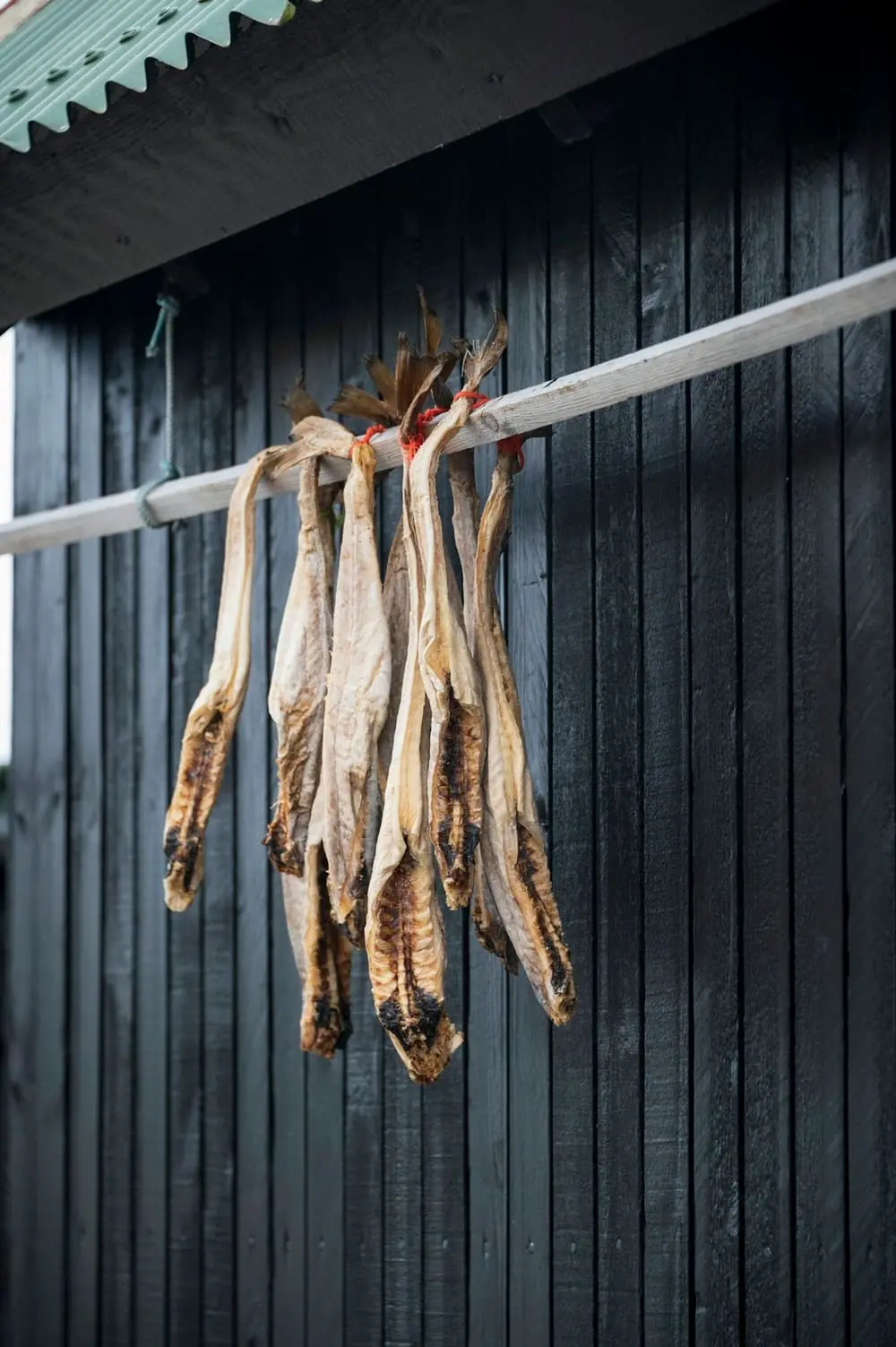 🐟 Hygienic hot-air dryingIllustrative
Managing surface drying and pathogen risk
Keep the surface open, keep the centre safe.
The temperature ceiling matters. Above roughly 50 °C, fish proteins denature and the surface sets — case hardening — trapping moisture inside a dry shell. The product then tests dry on the surface while remaining wet at the centre, which is exactly the condition in which spoilage organisms survive a nominally completed drying cycle.
| Parameter | Value |
|---|---|
| Thickness | 15–20 mm |
| Initial moisture | 75–80% |
| Final moisture | 15–20% |
| Loading density | 25–30 kg/m² |
| Drying temperature | 45–50 °C |
| Air velocity | 2.0–2.5 m/s |
| Relative humidity | 35–45% |
| Cycle time | 24–30 hours |
| Daily capacity | ~1,000 kg |
| Product yield | ~75% |
Hygiene infrastructure
Fish processing demands infrastructure that fruit processing does not:
- Clean-zone separation — cleaning station, preparation area and loading zone, physically separated from general zones.
- Personnel hygiene — sensor-operated hand-wash stations, boot-wash stations, change rooms with lockers and separate clean-uniform storage.
- Surfaces — stainless-steel work surfaces, non-porous floors, curved wall-to-floor joints, washable walls.
- Drainage — dedicated drainage with grease traps, separate from other streams.
- Waste handling — sealed containers, chilled storage, daily disposal, active odour control.
- Air management — positive pressure in processing areas, air locks between zones, regular air-quality monitoring.
Quality & safety metrics
- Salt content — consistency across the batch.
- Moisture levels — uniform, verified at multiple points.
- Protein preservation — nutritional value maintained.
- Microbial safety — validated pathogen reduction, documented per batch against WHO food-safety guidance ↗.
- Texture quality — appropriate to the target market’s expectations.
The species, one by one
The parameter that decides everything is neither size nor origin: it is fat content. It sets the temperature ceiling, because it sets the rancidity risk. A lean fish takes the top of the band without harm; an oily fish run at 55 °C will be correctly dried and rancid within three weeks.
This is why a dryer set once and left does not suit a landing site: bonga and Nile perch come ashore the same morning and do not want the same cycle. The twenty-eight species below cover most of what is commercially dried across West and Central Africa.
Reading the fat column
- Lean (under about 2 %) — takes the top of the band. Watch case hardening rather than rancidity.
- Medium (2 to 8 %) — middle of the band, and keep the air moving.
- Oily (over 8 %) — cap at 45 °C. Oxidation, not moisture, is what limits shelf life.
| Species | Fat class | Temperature (°C) | Target aᵥ | Yield | Notes |
|---|---|---|---|---|---|
| Freshwater | |||||
| TilapiaOreochromis niloticus | Lean | 45–50 | ≤ 0.70 | 3 : 1 | Farmed at scale across the region. Butterflied or filleted; the most predictable fish here. |
| African catfishClarias gariepinus | Medium | 45–50 | ≤ 0.70 | 3.5 : 1 | Usually smoke-dried. Fat sits under the skin, so it needs the lower end of the band. |
| Nile perch (capitaine)Lates niloticus | Lean | 45–52 | ≤ 0.70 | 3 : 1 | Large, lean and thick — split into even fillets or the centre will not finish with the edges. |
| Bagrid catfishChrysichthys spp. | Medium | 45–50 | ≤ 0.70 | 3.5 : 1 | A lagoon and river staple in Côte d’Ivoire, Ghana and Benin. |
| African bonytongueHeterotis niloticus | Medium | 45–50 | ≤ 0.70 | 3.5 : 1 | Sahelian floodplain fishery; firm flesh, dries evenly once scaled. |
| African snakeheadParachanna obscura | Lean | 45–52 | ≤ 0.70 | 3 : 1 | Lean and firm, holds shape well through a long cycle. |
| Small pelagics | |||||
| Bonga shadEthmalosa fimbriata | Oily | 40–45 | ≤ 0.70 | 3 : 1 | The West African staple, and the hardest to hold: very oily, so 45 °C is a ceiling, not a target. |
| SardinellaSardinella aurita / maderensis | Oily | 40–45 | ≤ 0.70 | 3 : 1 | Lands in huge seasonal pulses. Fat content swings with the season — check before setting the cycle. |
| AnchovyEngraulis encrasicolus | Oily | 40–45 | ≤ 0.70 | 4 : 1 | Dried whole and small, so it finishes fast — the risk is over-drying, not under. |
| Horse mackerelTrachurus trecae | Oily | 40–45 | ≤ 0.70 | 3 : 1 | Oily and abundant; a candidate for salt-drying rather than plain drying. |
| Large pelagics | |||||
| MackerelScomber / Scomberomorus spp. | Oily | 40–45 | ≤ 0.70 | 3 : 1 | High-value when handled well, rancid within weeks when not. |
| Tuna (skipjack, yellowfin)Katsuwonus / Thunnus spp. | Medium | 45–50 | ≤ 0.70 | 3.5 : 1 | Loined and strip-cut. Dark muscle discolours first — trim it or accept the grade. |
| BarracudaSphyraena spp. | Lean | 45–52 | ≤ 0.70 | 3 : 1 | Lean and firm; one of the easiest marine species to dry well. |
| Demersal and white fish | |||||
| CroakerPseudotolithus spp. | Lean | 45–52 | ≤ 0.70 | 3 : 1 | A mainstay of the Gulf of Guinea trawl catch. Lean, forgiving, good colour. |
| ThreadfinGaleoides decadactylus | Medium | 45–50 | ≤ 0.70 | 3 : 1 | Widely traded dried across the coast. |
| TonguesoleCynoglossus spp. | Lean | 45–52 | ≤ 0.70 | 3.5 : 1 | Thin and flat, so it dries fast and unevenly if the load is not laid out properly. |
| GrouperEpinephelus spp. | Lean | 45–52 | ≤ 0.70 | 3 : 1 | High value; usually worth selling fresh unless the cold chain fails. |
| Sea breamSparidae | Medium | 45–50 | ≤ 0.70 | 3 : 1 | Consistent size grading makes this an easy species to batch. |
| Ray and skateRajiformes | Lean | 45–50 | ≤ 0.70 | 3.5 : 1 | Develops ammonia if held before processing — this one is about intake speed, not drying settings. |
| Crustaceans | |||||
| Shrimp and prawnPenaeus / Parapenaeopsis spp. | Lean | 50–55 | ≤ 0.70 | 4 : 1 | Blanched then dried. Takes the highest temperature here, and colour is the grade. |
| Dried crayfishPalaemonidae | Lean | 50–55 | ≤ 0.70 | 4 : 1 | The West African seasoning staple — enormous domestic demand, sold ground or whole. |
| CrabCallinectes spp. | Lean | 50–55 | ≤ 0.70 | 5 : 1 | Picked meat dries fast; whole crab is mostly shell and a poor use of chamber volume. |
| Cephalopods | |||||
| OctopusOctopus vulgaris | Lean | 45–50 | ≤ 0.70 | 5 : 1 | Very high water content, so the ratio is punishing — but the dried product carries an export premium. |
| Squid and cuttlefishLoligo / Sepia spp. | Lean | 45–50 | ≤ 0.70 | 5 : 1 | Scored and laid flat. Toughens quickly if driven above the band. |
| Other marine products | |||||
| OysterCrassostrea tulipa | Lean | 45–50 | ≤ 0.70 | 6 : 1 | Shucked and dried; a mangrove-estuary product in Senegal, Gambia and Guinea. |
| Sea cucumberHolothuroidea | Lean | 45–55 | ≤ 0.70 | 10 : 1 | Boiled then dried in stages over days. The highest-value dried marine product there is. |
| SeaweedEucheuma / Kappaphycus | Lean | 40–45 | ≤ 0.70 | 8 : 1 | Farmed for carrageenan. Buyers specify moisture tightly, and sun-drying rarely meets it. |
Yield is whole fresh weight to one part finished product. Temperature bands and water-activity targets are ordinary processing practice, to be validated against your own product and market: they are sizing starting points, not a validated recipe.
Explore further
By country and crop
Each page carries that country’s harvest calendar, the biomass fuel available locally, and a worked sizing example.
Fish drying in Mali · Fish drying in Senegal · Fish drying in Guinea
- Hot-air generators — indirect heat and humidity control for low-temperature fish drying.
- Industrial tunnel dryers and batch units — hygienic, food-grade chambers.
- Fruit & vegetable drying — the same platform, different parameters.
- Worked use cases — engineered configurations across the region.
- Food-safety standards: Codex Alimentarius (FAO/WHO) ↗
Frequently asked questions
Why not dry hotter and finish faster?
Above roughly 50 °C the protein begins to coagulate at the surface: texture changes and a crust forms that traps moisture inside. The 45–50 °C band over a 24–30 hour cycle, at 2.0 to 2.5 m/s, is the trade between drying speed and product integrity — and it is why fish takes roughly twice as long as mango on the same equipment.
How is food safety managed?
Through process control and through design: intake, preparation, drying and packing zoned in one direction, food-grade surfaces, full cleaning access, and PLC logging of temperature and time per batch. The 15–20 % final moisture is the barrier; the documentation is the evidence.
Can fish and fruit be dried in the same facility?
Yes, but it has to be designed that way from the start: separate preparation areas, dedicated tunnels, and independent waste and drainage routes. The two also want different windows — 45–50 °C for fish against 65–70 °C for fruit. Retrofitting fish onto a single-product facility is difficult and usually fails a food-safety audit.
Request a fish drying system quote
We design the hygiene infrastructure and drying parameters together, for domestic or export specification.
Request a quote