Six-chamber mango drying line — Banfora design scenario
A six-chamber container line for Banfora.
A six-chamber mango drying line for a cooperative in the Banfora region, built from 20 ft container conversions at 828 kg fresh per chamber. The line takes 4,968 kg of fresh mango per batch on a 14-hour cycle, fired by a 600,000 kcal/h cashew shell burner running at about 77 % of rating.
The Banfora region produces exceptional mangoes and loses a great deal of them. In the Banfora region the processing challenge is five interlocking ones: a harvest arriving faster than anyone could handle, unreliable and expensive grid power, export buyers demanding consistency, traditional drying consuming fuelwood unsustainably, and almost no value addition for growers.
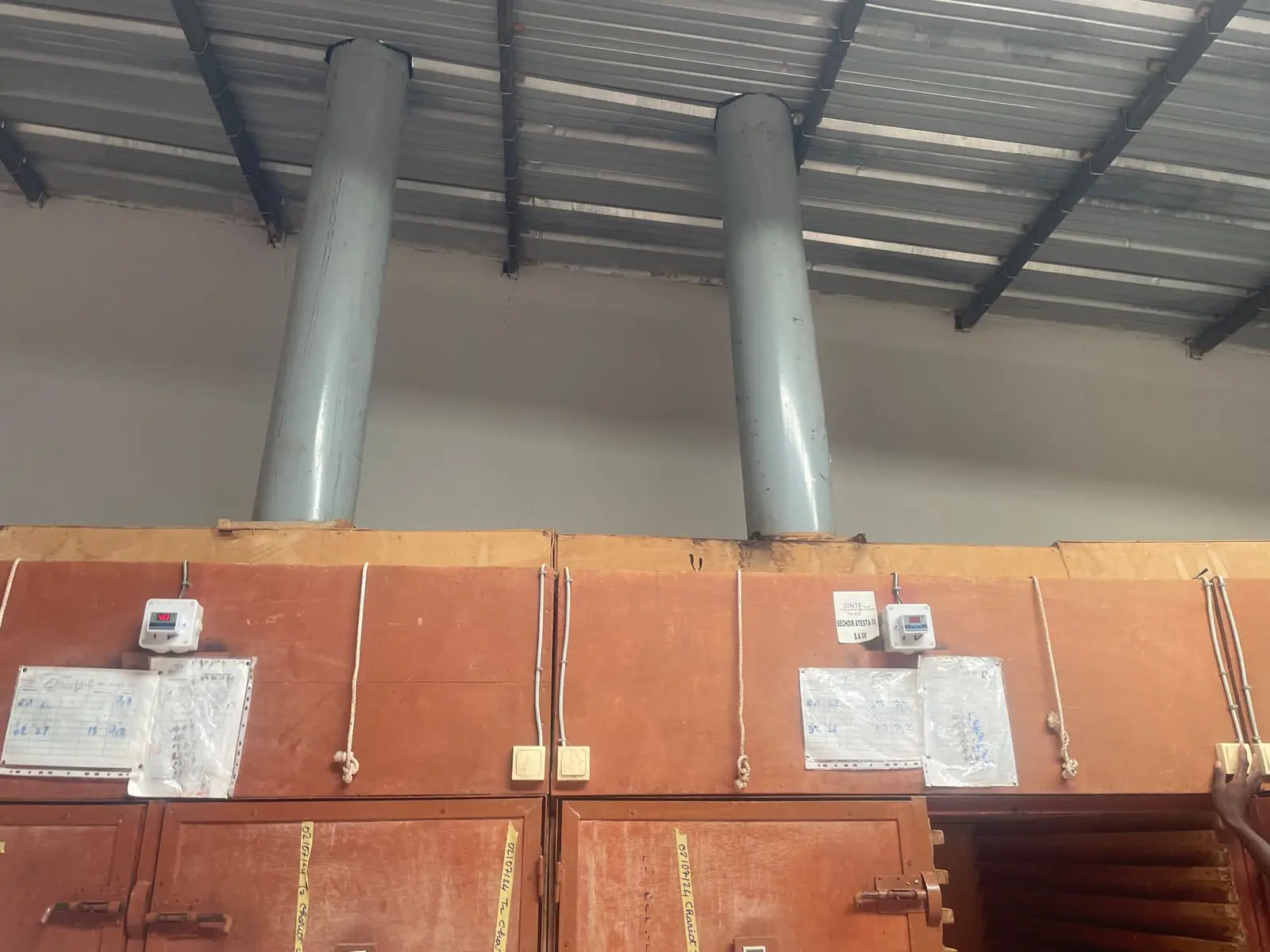 Supply air · 65 °C at the tray📍 Banfora scenarioIllustrative
A complete residue-fuelled line
- 600,000 kcal/h cashew-shell burner with PLC common panel
- Hot-air generator — double chamber, three-pass, indirect exchange
- Six container chambers — 20 ft conversions, Rockwool-lined, 828 kg fresh per chamber
- Per-chamber air — 5 HP recirculation fan, 1 HP exhaust with motorised damper
- Ducting — 3mm MS with volume-control dampers, 80mm rockwool, MERV-8 filtration
- Segregated hygiene zones + operator & maintenance training
Projected outcomes (modelled design targets)
- Processing capacity increased substantially over prior manual methods.
- Consistent moisture at 12–14% with markedly improved colour retention.
- Significant reduction in processing energy cost through residue-fuel substitution.
- Product quality meeting the specification required for European buyers.
- New permanent positions created for processing operations.
- Reduced fuelwood consumption relative to traditional drying.
Principles we design around
- Fuel supply chains need building, not assuming. A cashew-shell burner is only as reliable as the shell supply, so we scope collection arrangements with nearby processors alongside the equipment.
- Training depth determines outcomes. The gap between a well-run and a poorly-run line is operator competence, not equipment specification — so training is part of the supply.
- Preventive maintenance must be scheduled, not intended. We hand over written schedules with named responsibility, or it does not happen.
- Local adaptation is unavoidable. Design assumptions are confirmed against a site survey before manufacture.
What this scenario is
A costed design we are ready to build, and not a delivered project. GreenMach has one commissioned installation — a 900,000 kcal/h cashew shell burner firing a steam boiler at PCCL in The Gambia — and it is a boiler application. No drying line has been built anywhere yet.
Everything below is engineering: the equipment list, the arithmetic that sized the burner, and the four site conditions that would change the answer. It is published in this much detail because a buyer comparing suppliers deserves to see the working, not a capacity figure and a photograph.
The line, item by item
| Item | Specification |
|---|---|
| Burner | 600,000 kcal/h cashew shell burner, staged pyrolytic combustion |
| Hot air generator | Double chamber, three-pass, indirect exchange |
| Central AHU | 10 HP blower, MERV 8 filtration, mixing box |
| Chambers | 6 × 20 ft container conversions, Rockwool-lined |
| Chamber recirculation fan | 5 HP, 13,000 m³/h, high-temperature bearings |
| Chamber exhaust fan | 1 HP with motorised damper |
| Chamber instrumentation | 2 × PT100, RH probe, IP65 light, door switch |
| Wagons | 1,000 × 1,050 × 1,890 mm, 23 levels, 46 trays each |
| Trays | 900 × 500 × 25 mm, SS 304 angle frame, SS 304 woven mesh deck |
| Ducting | 3 mm MS, 80 mm Rockwool at 65 kg/m³, opposed-blade volume dampers min. 400 mm, 83 m² total |
| Control | Master PLC over burner, HAG, 6 chamber zones, 6 recirculation and 6 exhaust fans |
| Supply air to trays | 65 °C, capped by hard PLC interlock at the tray face |
How the burner was sized
This is the section worth reading, because it is the one most suppliers replace with a capacity table. The duty is not chosen from a range; it is derived from the water that has to leave the fruit.
| Step | Figure |
|---|---|
| Line batch | 6 × 828 kg = 4,968 kg fresh mango |
| Dried output | 496.8 kg at a 10:1 whole-fruit yield |
| Water to remove | 4,968 − 496.8 = 4,471 kg per batch |
| Removal rate | 4,471 kg ÷ 14 h = 319 kg/h |
| Evaporation load | 205.8 kW |
| Envelope loss | 9 kW |
| Useful heat | 214.8 kW |
| Overall efficiency used | 0.40 fuel-to-evaporation |
| Fuel input required | 214.8 ÷ 0.40 = 537 kW, about 462,000 kcal/h |
| Burner selected | 600,000 kcal/h — about 77 % of rating |
The 0.40 is the whole chain of losses, not combustion efficiency. Written out: combustion 0.85 × hot air generator 0.78 × ducting 0.95 × envelope 0.97 × exhaust 0.68. Those five multiply to 0.415; sizing is carried at 0.40, the more conservative figure, and it is the divisor above. Both are stated so the arithmetic can be checked rather than taken on trust.
The headroom between 462,000 and 600,000 kcal/h is deliberate and it is not padding. A burner sized exactly to the calculated duty has nothing left for fruit that arrives wet after rain, for a cold morning at the start of the season, or for a batch of shell that was stored badly. Those are ordinary conditions in Banfora, not exceptions, and a line that stalls on them loses the day.
The chamber
Each chamber is a 20 ft container converted rather than a purpose-built room. The container gives a rigid, weathertight, transportable shell and fixes the footprint, which is what sets the 828 kg — eight wagons, two abreast and four deep, and no more.
The original marine-plywood deck is stripped out entirely. This is not a finish decision. Container decking is tropical hardwood ply treated with pesticide, and it is not an acceptable surface under 65 °C recirculating air in a chamber handling food. It is replaced with a 1.5 mm SS 304 wearing deck, seam-welded and coved up to the walls so there is no joint for product or wash water to sit in.
Walls, blind end and door panels are 50 mm Rockwool sandwich at 100 kg/m³ lamellar; ceiling and floor panels are 80 mm. All of it is non-combustible A1 to EN 13501-1 — the classification matters because the chamber sits next to a solid-fuel burner, and a panel that contributes to a fire is a different risk from one that merely fails.
Air-seal baffles close the gaps between the wagons and the chamber walls. Without them air takes the free path around the load rather than through it, and the result is not a slower dry but an uneven one: trays at the edges finish while the middle of the wagon is still wet, and the batch has to be judged on its worst tray.
Trays, wagons and loading
| Parameter | Value |
|---|---|
| Tray | 900 × 500 × 25 mm, SS 304 frame and woven mesh deck |
| Tray pitch | 70 mm, giving a 45 mm free air channel per level |
| Levels per wagon | 23 |
| Trays per wagon | 46 |
| Tray area per wagon | 20.7 m² |
| Wagons per chamber | 8 — two abreast, four deep |
| Trays per chamber | 368, giving 165.6 m² of tray area |
| Mango loading density | 5 kg fresh per m² of tray |
| Chamber capacity | 828 kg fresh per batch |
| Line total | 48 wagons, 2,208 trays, 993.6 m², 4,968 kg fresh |
What we would need to confirm on site
Four assumptions carry the design, and all four are checked before manufacture rather than after commissioning. Naming them is not hedging — it is the difference between a quotation and a guess.
- Mango loading density. The 5 kg/m² figure is provisional and is being verified. Variety, ripeness at intake and slice thickness all move it, and it drives the chamber count directly.
- Design ambient. 35 °C is the assumption for the Banfora drying season. A wetter or cooler site changes the evaporation load more than the temperature alone suggests.
- Grid supply. Supply is subject to interruption. What that means for the control strategy, and whether the line needs to survive a cut mid-cycle without spoiling a batch, is decided before the panel is built.
- Shell supply. A cashew shell burner is only as reliable as the shell reaching it. Collection arrangements with nearby processors are scoped alongside the equipment, not assumed.
Modelled design targets, not measured results
The figures above are modelled design targets for this configuration, not measured results — we have not yet built this line. They are confirmed against a site survey and a real fuel sample before manufacture.
Frequently asked questions
Why container conversions rather than purpose-built rooms?
Because the shell already exists, is rigid and weathertight, and can be transported complete. The trade is a fixed footprint: a 20 ft chamber holds 8 wagons and therefore 828 kg, where a purpose-built panel room can be sized freely. A cooperative site with restricted civil works usually finds that trade worth making.
Why is the burner larger than the calculated duty?
The calculation gives about 462,000 kcal/h and the selection is 600,000, so it runs near 77 % of rating. That margin covers fruit arriving wet, cold mornings early in the season, and damp fuel. All three are ordinary conditions in Banfora, and a line with no headroom stalls on the first of them.
What happens to the container floor?
It comes out. Marine-plywood decking is pesticide-treated tropical hardwood, which is not acceptable under 65 °C recirculating air in a food chamber. It is replaced with a 1.5 mm SS 304 wearing deck, seam-welded and coved to the walls so there is no joint holding product or wash water.
Can this line dry anything other than mango?
Yes, and it should. A mango campaign in the Cascades runs about 100 days. The same chambers take tomato, onion, chilli or fish out of season at their own recipes, anywhere in the 40 to 100 °C range — subject to a full wet clean between products, which is a shift rather than an hour.
Planning a mango processing line?
We’ll scope a configuration around your harvest volume, fuel supply and target markets.
Start a conversation