Panel rooms and waste-to-feed — Bobo-Dioulasso design scenario
One heat plant, three duties.
A six-room panel drying line for Bobo-Dioulasso, paired with a unit turning mango peel and trim into livestock feed. The rooms take 4,968 kg of fresh mango per batch, and the waste stream that would otherwise need disposing of becomes both a second product and part of the fuel.
An established Hauts-Bassins mango dryer — receiving, ripening, peeling, slicing, drying and vacuum-packing for export. GreenMach’s proposed supply would replace the heat source, add drying capacity, and add a waste-to-feed line around the existing flow.
 Design setpoint · 118 °C📍 Bobo-Dioulasso scenarioIllustrative
Panel rooms, central biomass plant and feed unit
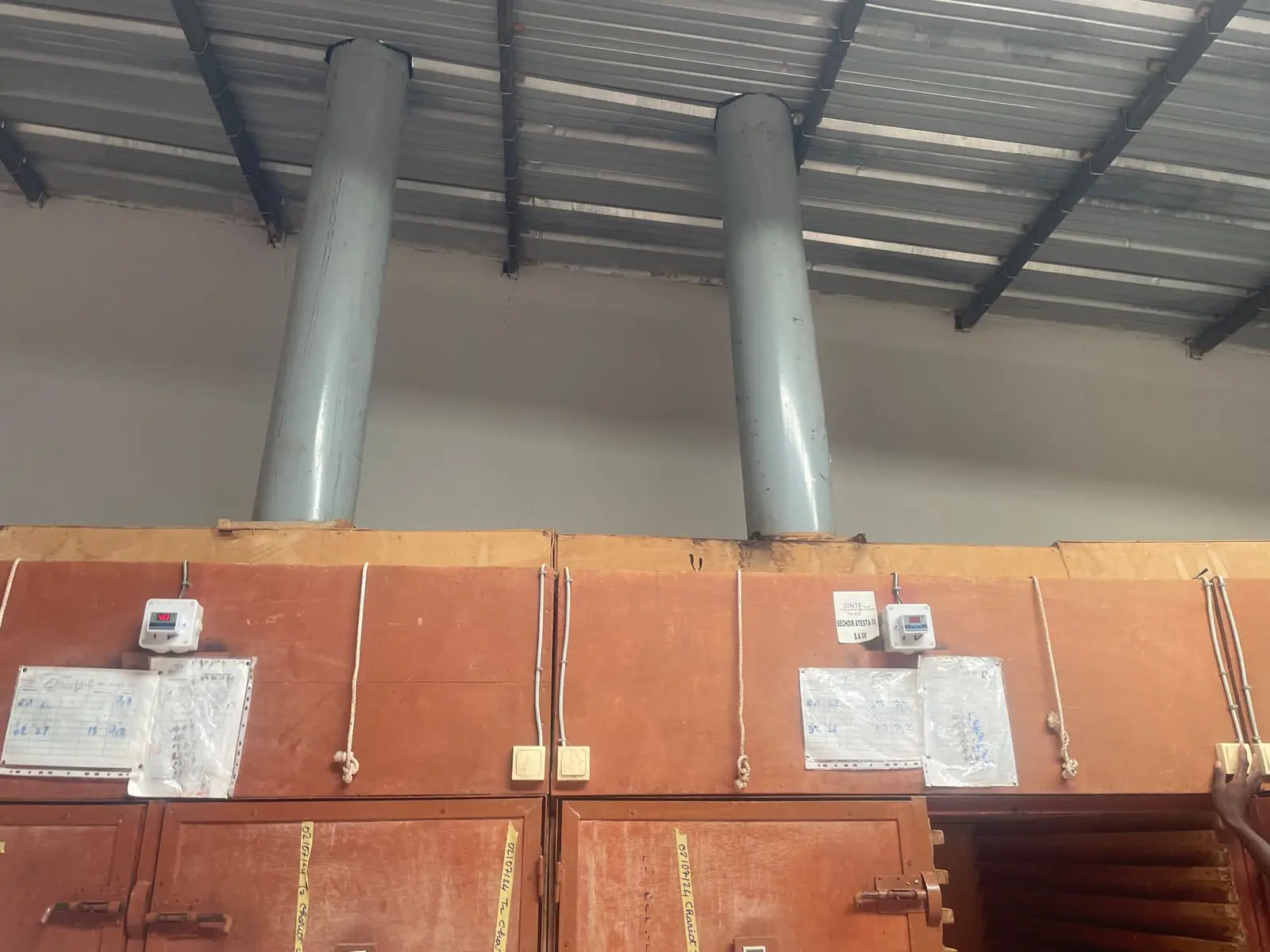
- Drying — 6 Rockwool panel rooms under a PEB steel shed
- Line batch — 4,968 kg fresh mango (≈497 kg dried)
- Heat plant — Central cashew-shell pyrolysis burner, 600,000 kcal/h
- Hot-air generator — Indirect double-chamber, three-pass — no gas contact
- Feed unit — Mango waste → pelletised feed, 5 t/day wet in
- Whole-line load — ~56 HP (vs 75.5 HP for a full-flow design)
Why replace the heat source
The incumbent burns banked LPG cylinders — imported, hard-currency fuel — to feed the existing dryers. GreenMach’s cashew-shell plant would displace that with a regional residue at ~4,800 kcal/kg, and the pyrolysis design handles the corrosive CNSL fraction that fouls equipment when shell is burned raw.
Three integrated duties
- Food drying — six independent panel rooms let batches be staggered rather than all moving together, at a tray-face temperature capped at 65 °C for EU-export dried mango.
- Waste valorisation — the same burner dries mango peel and trimmings for a pelletised livestock feed line running in the same season.
- Room to grow — the 600,000 kcal/h burner carries headroom for roughly two further chambers on the same plant (client cap 900,000 kcal/h).
What this scenario is
A costed design we are ready to build, not a delivered project. GreenMach has one commissioned installation — a cashew shell burner firing a steam boiler at PCCL in The Gambia — and no drying line anywhere yet.
The figures below are engineered design targets, sized from an assumed throughput that would be confirmed against real intake before anything is manufactured.
The line, item by item
| Item | Specification |
|---|---|
| Chambers | 6 insulated panel rooms, 100 mm Rockwool sandwich on a concrete slab |
| Building | Light steel PEB shed over the rooms — cold-store construction, food-grade |
| Line batch | 4,968 kg fresh mango |
| Heat plant | Cashew shell burner and hot air generator serving all six rooms |
| Recirculation | Per room, so one room can be cleaned while the others run |
| Trays and wagons | SS 304 throughout |
| Waste line | Peel and trim collection, drying and briquetting for feed and fuel |
How the line was sized
The method is the same one set out for the Banfora scenario, run against a different throughput assumption. Fresh intake gives the water to remove; the cycle gives the rate; the rate divided by the efficiency chain gives the fuel input.
The chain is combustion 0.85 × hot air generator 0.78 × ducting 0.95 × envelope 0.97 × exhaust 0.68 — 0.415 multiplied out, carried at 0.40 for sizing. The exhaust term is the largest and is not a fault: carrying moisture out of the room in warm air is how drying works.
The waste-to-feed line changes the arithmetic in a way a pure drying line cannot. Peel and trim are roughly a third of the intake by weight, and they leave the process wet. Drying them is a real thermal load and has to be in the sizing, not bolted on afterwards — but briquetted mango peel returns about 4,200 kcal/kg to the burner, so part of that load pays for itself.
What we would need to confirm on site
The throughput assumption is the largest uncertainty and the one that moves everything else. These are established at survey.
- Real peak-day intake. Not the season average and not the cooperative’s target — what actually arrives at the gate on the busiest day of the campaign.
- Waste fraction. Peel and stone share varies by variety and by how the fruit is cut. It sets both the feed output and the fuel contribution.
- Feed buyer. Dried mango waste is only a product if someone is buying it. The specification the buyer wants decides the drying regime for the second line.
- Grid supply. Subject to interruption, which decides the control strategy before the panel is built.
Modelled design targets, not measured results
Ce sont des objectifs de conception modélisés pour cette configuration, non des résultats mesurés — nous n’avons pas encore construit cette installation.
Frequently asked questions
Why panel rooms instead of tunnels here?
Because the site allows it and the product mix argues for it. Six rooms with independent recirculation, 828 kg fresh each, can run different recipes at once, and one can be taken down for a wet clean while the other five keep working. A tunnel line favours throughput on a single product instead.
Is the waste-to-feed line worth building?
It depends entirely on whether a feed buyer exists locally, which is a market question rather than an engineering one. What is certain is the fuel side: briquetted mango peel returns about 4,200 kcal/kg to the same burner, against a disposal cost for the same material of somewhat more than nothing.
How much of the intake ends up as waste?
Roughly a third by weight as peel and trim, with the stone on top of that, though it varies with variety and with how the fruit is cut. At a 4,968 kg line batch that is a substantial wet stream arriving every day of the campaign, and it has to go somewhere.
Planning a mango line — food, feed or both?
We’ll scope the heat plant, the drying rooms and the waste line as one integrated supply.
Start a conversation